Inês Cardoso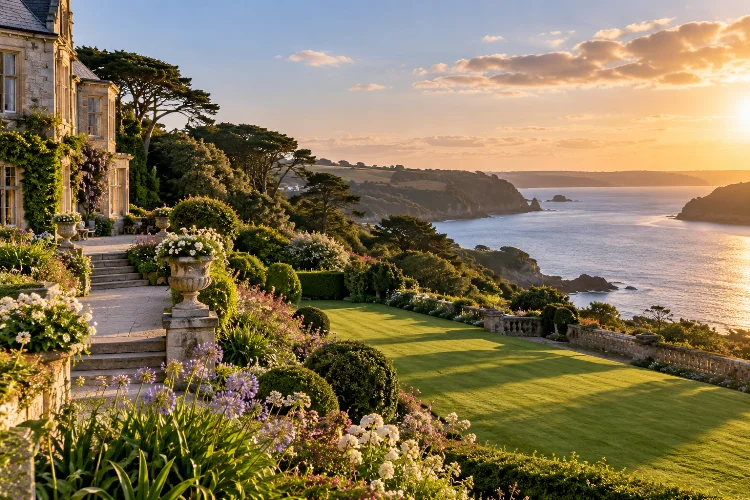
Cornwall’s historic estates become especially interesting when the garden does not stop at a stone wall.
In several parts of the county, lawns fall toward estuaries, woodland valleys end beside beaches, and carefully positioned houses use distant water almost like another architectural feature.
That relationship is the focus when exploring historic Cornwall estates with strong coastal and garden connections. These properties tell stories about wealthy families and architecture, but they also reveal how geography shaped gardening.
Sheltered valleys helped unusual plants survive, maritime views influenced the positioning of houses, and access to rivers connected estates with wider commercial and social networks.
Places such as Trelissick, Mount Edgcumbe, Antony, Glendurgan, and Caerhays show completely different versions of this relationship.
Some combine formal country-house design with sweeping estuary views. Others are better understood as wooded gardens gradually descending toward the water.
Together, they offer one of the most rewarding ways to explore Cornwall beyond its familiar beaches and fishing villages.
Start at Trelissick Where the Estuary Becomes Part of the Estate
Trelissick is one of the clearest examples of a Cornish house designed around its wider landscape.
John Lawrence began creating a villa and garden here in the 1750s, choosing a site with commanding views across the Fal estuary toward Falmouth and the sea. Later owners expanded the house, including the Daniell family, who added prominent architectural features during the nineteenth century.
Those views are not just pleasant background scenery. They are central to how the estate feels.
As you move between the house, lawns, trees, orchard areas, and garden paths, the Fal repeatedly appears between planting and open spaces. Tide, weather, boats, and changing light mean the view is never completely static.
This is a useful place to understand the idea of a borrowed landscape: scenery outside the formal garden becomes part of the visual composition.
Explore Mount Edgcumbe as a Complete Coastal Landscape
Mount Edgcumbe takes the house-and-sea relationship to a much larger scale.
Its country park covers about 865 acres on the Rame Peninsula and includes formal gardens, woodland, historic structures, parkland, coastal terrain, and part of the South West Coast Path. The Tudor-style house stands within a Grade I listed landscape overlooking Plymouth Sound.
The house itself was built between 1547 and 1550. Unusually for its period, its design placed significant emphasis on looking outward toward the views rather than creating the more defensive, inward-facing arrangement associated with earlier buildings
The gardens developed over generations and now contain layers ranging from formal European-inspired spaces to exotic planting. Around seven acres of formal gardens stretch from the lower park toward areas surrounding the house.
Allow several hours here. Walking between coast, architecture, gardens, and parkland explains Mount Edgcumbe far better than visiting the house alone.
See an Estuary Landscape From Antony
Antony offers a quieter but equally sophisticated relationship with water.
The current house was constructed in the 1720s on land associated with the Carew family since the fifteenth century. It occupies a position above the River Lynher, where the estate takes advantage of broad views toward the estuary and the wider Plymouth area
That setting matters because eighteenth-century estate design was often about controlling what the visitor saw.
Lawns, trees, open ground, and water could be arranged to make a landscape appear naturally beautiful even when much thought had gone into its composition. Antony is a good place to slow down and notice how frequently the estuary is framed between vegetation.
Historic records also show how closely the household interacted with its watery enviroment. An earlier Antony estate included a fishpond designed to accommodate freshwater and saltwater fish.
The result is an estate where river landscape, family history, and domestic architecture feel closely connected.
Follow Glendurgan’s Valleys All the Way to the Water
Glendurgan approaches the coastal-estate idea differently because the garden itself is the main experience.
Alfred and Sarah Fox began creating the garden during the 1820s. They developed its three valleys with exotic plants, orchards, family spaces, and the famous cherry-laurel maze planted in 1833.
The geography is what makes it special.
Paths descend gradually from the upper garden through increasingly lush vegetation toward the small riverside settlement of Durgan and its beach on the Helford River.
Why the Maritime Setting Matters
Cornwall’s relatively mild and damp conditions allow plants from temperate regions around the world to thrive here. At Glendurgan, large-leaved plants, bamboo, tree ferns, magnolias, camellias, and other specimens take advantage of the sheltered valley conditions.
Instead of a formal garden sitting beside a mansion, Glendurgan feels like a landscape journey.
You begin among ornamental planting and eventually arrive beside boats and water. That physical transition is one of the strongest garden-to-coast experiences in Cornwall.
Visit Caerhays for a Castle, Woodland and Beach in One Landscape
Caerhays arguably has the most dramatic combination of garden and coastline.
The estate occupies the sheltered Porthluney valley on Cornwall’s south coast. John Nash designed the castle for the Trevanion family, with construction taking place between 1807 and 1810. The Williams family later developed the property and its internationally significant gardens.
Today, more than 140 acres of woodland garden surround the castle. The collection became especially important after 1900, when new plants arriving from China were introduced through the work of plant collectors and their sponsors
The coastal microclimate plays a direct role.
Sheltered woodland protects plants from the strongest westerly winds, while moisture from sea mist helps create conditions suited to many magnolias and rhododendrons. Acidic soils provide another advantage
Then there is Porthluney Beach, just beyond the estate.
Garden walks can reveal views over the grounds, lake, castle, and out toward the sea, making the coastline a real part of the visual experience rather than a seperate attraction.
Notice How Cornwall’s Climate Changed Garden Design
Visiting several of these estates makes one pattern obvious: Cornwall’s gardens are strongly influenced by climate.
The surrounding ocean moderates temperatures compared with many inland parts of Britain. Sheltered valleys add further protection, making southern Cornwall particularly suitable for plants associated with temperate regions overseas.
This helps explain the abundance of camellias, rhododendrons, magnolias, tree ferns, and other exotic species at estates such as Glendurgan and Caerhays. It also explains why spring can be such an important season for historic Cornish gardens
But plants are only part of the story.
Coastal weather also affects garden layout. Trees can provide wind protection, valleys capture moisture, while elevated lawns and terraces are positioned to make the most of distant water views.
In other words, the coast does not simply sit beside these gardens. It helped shape them.
Plan a Coastal Estate Route Over Several Days
These properties are spread across southern and eastern Cornwall, so trying to visit them all in one weekend would feel unnecessarily rushed.
Trelissick and Glendurgan work naturally within a Falmouth-area stay. Caerhays can be combined with the Roseland Peninsula or Mevagissey, while Antony and Mount Edgcumbe fit particularly well into an exploration of the Rame Peninsula and south-east Cornwall.
Spring is a strong season for garden-focused travel, especially if magnolias, camellias, and rhododendrons are priorities. Caerhays has a particularly seasonal visitor programme centred on its spring garden, so check opening dates before making a detour.
Allow at least half a day for major properties and longer for Mount Edgcumbe.
Wear proper walking shoes as well. Historic gardens are not always smooth formal spaces; slopes, woodland paths, grass, and wet surfaces are part of the experiance.
Historic Cornwall estates with strong coastal and garden connections reveal how closely architecture, horticulture, and geography can interact.
At Trelissick, the Fal estuary becomes part of the designed view. Mount Edgcumbe combines a Tudor house, layered gardens, parkland, and coastline on an enormous scale.
Antony uses the Lynher estuary as part of its setting, while Glendurgan turns a garden walk into a gradual journey toward the Helford River. Caerhays adds a castle, specialist woodland planting, and the sea within one remarkable landscape.
Choose two or three estates that fit your route rather than racing between all of them. Spend time looking beyond the flowers and façades, and you will start to see how Cornwall’s coast shaped the gardens themselves.