Inês Cardoso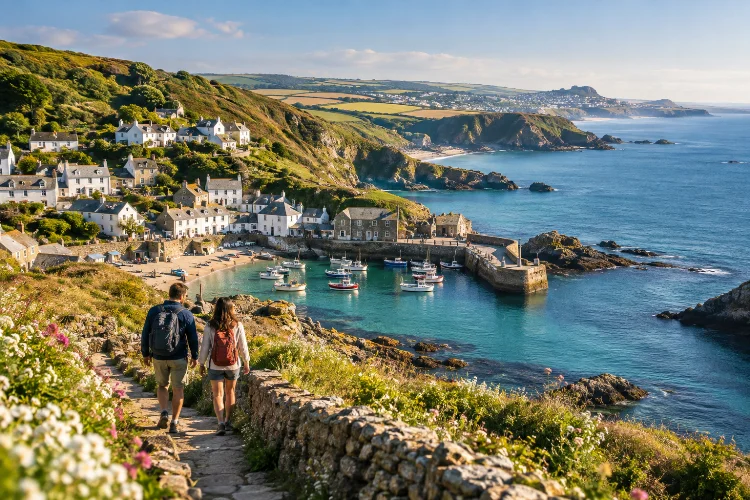
Cornwall is full of coastal villages that could easily justify an entire weekend on their own. The challenge is connecting them into one journey without spending most of the holiday driving, searching for parking, or rushing away just as a harbour starts to feel interesting.
A better approach is to follow the peninsula gradually. Begin among the sheltered fishing villages of South Cornwall, curve around the Lizard and far west, then continue along the wilder Atlantic coast toward North Cornwall.
This turns linking Cornwall’s best coastal villages into one epic journey into something more memorable than a collection of day trips.
Along the way, the landscape keeps changing. You move from tiny working harbours and wooded estuaries to granite headlands, whitewashed cottages, steep cliff paths, and broad Atlantic horizons. Cornwall has roughly 300 miles of coastline, so trying to experience everything is unrealistic.
The goal is to choose villages with distinct character and connect them at a pace that still leaves time to wander.
Begin in Polperro for a Classic South Coast Arrival
Polperro makes a strong starting point because it immediately delivers the atmosphere people imagine when planning a Cornish coastal road trip.
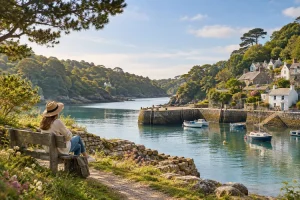
The village sits around a compact harbour at the bottom of a steep valley, with white and stone cottages packed tightly along narrow streets.
Much of the centre is effectively better explored on foot, and visitors are encouraged to leave cars in the main parking area rather than attempt the tiny village lanes.
Spend your first afternoon wandering around the harbour before walking a short stretch of the South West Coast Path toward Talland Bay. That combination of village exploration and cliff walking creates a much better introduction than immediately jumping back into the car.
Stay locally or around nearby Looe if you want a wider range of accomodation.
Continue Through Mevagissey and St Mawes
From Polperro, move west through South Cornwall toward Mevagissey.
This working fishing village is built around a distinctive twin harbour, with narrow streets, cafés, galleries, pubs, and seafood restaurants clustered around the waterfront. Fishing remains visible rather than existing purely as heritage decoration.
Do not try to drive through its historic centre simply because your navigation app suggests it. Visit Cornwall recommends using parking on the approach and walking into the village because the old streets are extremely narrow.
From there, continue toward the Roseland Peninsula and St Mawes. The atmosphere changes again: sailing boats replace some of the fishing activity, while the Fal Estuary gives the landscape a softer, more sheltered feeling.
St Mawes has year-round ferry connections with Falmouth, and the crossing takes around 20 minutes.
Current schedules vary seasonally and sailings remain dependent on tide, weather, and operating conditions, so check the live timetable rather than building your day around an old screenshot.
Detour South to Cadgwith on the Lizard Peninsula
The next section should not follow the fastest road west.
Instead, turn toward the Lizard Peninsula and stay around Cadgwith, Coverack, or one of the surrounding villages. The eastern Lizard is reached through a network of smaller roads, but that slower access is part of what keeps the area feeling different from Cornwall’s larger resort towns.
Cadgwith is particularly memorable. Two small shingle beaches sit around a rocky promontory, with working fishing boats pulled up close to the village. A short section of the Coast Path leads toward the Devil’s Frying Pan, a dramatic feature created by a collapsed sea cave.
Allow a full day for the Lizard rather than treating it as a quick stop. The coastal roads look short on a map but can take considerably longer than expected.
Reach Mousehole Through Cornwall’s Far West
From the Lizard, continue toward Mount’s Bay and Mousehole, around three miles west of Penzance.
Mousehole retains a historic harbour framed by tightly packed houses and small lanes. At low tide, sandy areas appear inside the harbour, while the waterfront offers views across Mount’s Bay.
Regular buses also connect the village with Penzance, which can be useful if you prefer leaving the car at your accomodation.
Do not arrive simply to take a photograph and leave.
Spend an evening here, then use the following morning for a walk toward Lamorna Cove or explore nearby Newlyn before heading north around West Cornwall.
This is also a sensible point to slow the itinerary down. After several days of moving between villages, two nights around Penzance or Mousehole can prevent the trip from becoming a constant cycle of packing and checking in.
Cross West Cornwall Toward the Atlantic Coast
The journey changes character as you move from Mount’s Bay toward St Ives and the north coast.
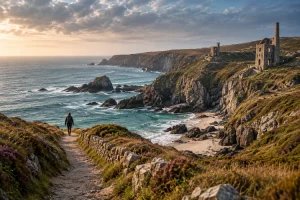
You could drive directly, but a more interesting route bends through West Penwith. Small communities, old mining landscapes, granite walls, exposed moorland, and Atlantic viewpoints make this stretch feel more remote than the mileage suggests.
St Ives itself is considerably larger and busier than the other stops in this itinerary, so treat it as a useful transition point rather than another tiny village. Have lunch, walk the coast, then continue east along North Cornwall.
This is where weather becomes more important.
The Atlantic-facing side is typically more exposed, and the South West Coast Path advises walkers to check forecasts, remain away from cliff edges, carry suitable clothing, and check tides before crossing beaches. Mobile reception can also be patchy
Make Port Isaac a Two-Night Stop
Port Isaac deserves more time than a hurried afternoon.
The traditional fishing village sits around a small harbour reached through steep, winding streets. Its fishing history dates back centuries, while boats still work from the harbour today.
Parking inside the historic centre is extremely limited, so visitors are advised to use the larger car parks above the village and walk downhill.
Stay two nights if your schedule allows.
On the first day, simply explore Port Isaac itself. The next morning, walk toward quieter Port Gaverne or continue west toward Port Quin.
Visit Cornwall describes the circular Port Isaac–Port Quin walk as roughly five miles, but the repeated climbs and descents make the route more demanding than the mileage suggests.
This is a good reminder to plan walking stages seperately from driving distances.
Finish Among the Cliffs of Boscastle
Boscastle gives the journey a suitably dramatic ending.
Unlike Cornwall’s open sandy bays, the village occupies a narrow valley that leads toward a twisting rocky harbour entrance. Historic buildings around the harbour reflect both fishing and trading heritage, while paths climbing above the water quickly reveal the rugged character of the north coast.
Walk out along the harbour before climbing onto the Coast Path for elevated sea views. At the right state of the tide and in suitable conditions, a blowhole near the harbour entrance can also become visible
Boscastle works well as the final overnight stay because the landscape feels noticeably wilder than where the journey began.
Turn the Route Into a 7-10 Day Journey
Seven days is possible, but nine or ten feels much more relaxed.
A practical rhythm is one major village per day, with occasional pairs such as Polperro and Mevagissey. Give St Mawes, the Lizard, Mousehole, and Port Isaac enough time for short coastal walks rather than treating every day as a transfer.
A car provides the most flexibility for the complete route, but you do not need to drive everywhere. Cornwall’s bus network connects many towns and villages, although timetables and routes can change.
Transport for Cornwall introduced significant network changes in February 2026, so use its live journey planner when arranging public-transport sections rather than relying on older travel blogs.
Keep one flexible day as well. Cornwall’s weather can change quickly, and having room to swap a long cliff walk for a shorter harbour day is definately worth it.
Linking Cornwall’s best coastal villages into one epic journey works when the route feels connected rather than rushed.
Start among the sheltered harbours of Polperro and Mevagissey, cross the Roseland and Lizard, slow down around Mousehole, then follow the Atlantic coast toward Port Isaac and Boscastle.
The journey could technically be completed quickly, but that misses the point. Cornwall rewards travellers who park the car, follow a cliff path, stay for dinner, and let a small harbour occupy an entire afternoon.
Give yourself seven to ten days, verify transport and ferry schedules shortly before travelling, and leave one day intentionally flexible. Then use the villages as anchors rather than targets—the memorable parts often happen on the coastline between them.