Inês Cardoso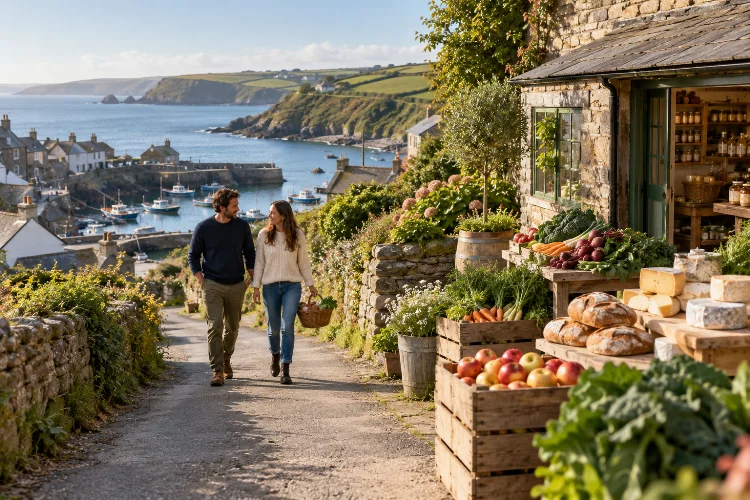
Cornwall’s food landscape makes more sense when you travel from the sea toward the fields.
Start the morning beside fishing boats unloading their catch, and within an hour you could be browsing vegetables grown on a family farm, tasting local cheese, or walking between apple trees used for Cornish cider.
That connection between coast and countryside is what makes Cornwall food trails that connect coastal villages and inland farms more interesting than a conventional restaurant itinerary.
Cornwall has roughly 300 miles of coastline, while inland fields support dairy farming, livestock, vegetables, orchards, and a growing community of artisan producers.
Visit Cornwall describes the county’s food identity as firmly rooted in produce from both land and sea
The best approach is not to drive from one famous food business to another. Build small regional loops instead. Pair a fishing harbour with a farm shop, use farmers’ markets as anchors, and let seasonal produce decide some of what you eat.
Think in Regional Food Clusters Instead of One Long Route
Cornwall looks relatively compact, but rural roads can make ambitious food itineraries surprisingly inefficient. A farm and fishing village separated by only a modest distance on the map may still involve winding lanes and slow driving.
A better strategy is to choose one geographical area each day.
Around Truro and west-central Cornwall, you can combine markets, farms, cider orchards, and the north coast.
Farther north, Padstow connects coastal food culture with surrounding farmland. South-east Cornwall offers another combination of fishing villages, market towns, and agricultural countryside.
This approach also reduces the temptation to turn every producer into a ten-minute shopping stop. Two or three meaningful visits usually create a richer day than eight rushed ones.
Start on the Coast Where Seafood Has a Local Context
Working harbours provide the clearest connection between Cornwall’s landscape and what appears on the plate.
Mevagissey is an especially useful example. Its twin harbour still shelters fishing boats that land catches regularly, while seafood businesses cluster throughout the old village. Historically, the local economy was strongly associated with pilchard fishing.
But “local seafood” should not mean ordering the same fish everywhere.
The Cornwall Good Seafood Guide currently rates fishery sustainability according to both species and capture method.
Its September 2026 recommendations classify scores of 1, 2, and 3 as recommended choices; examples include ring-netted Cornish sardines and potted Cornish king crab.
Ask what was landed recently and how it was caught. That creates a much stronger connection with the harbour than choosing solely from a permanent menu.
Move Inland to See Where the Rest of Lunch Comes From
Once you leave the coast, the other half of Cornwall’s food economy becomes visible.
Trevaskis Farm near Hayle is a useful example because it combines agriculture with direct retail. Its market sells homegrown fruit and vegetables alongside home-reared pork and locally sourced beef, poultry, dairy products, bakery goods, and other food.
Its farm park and pick-your-own operation is particularly active from roughly May through September, although the farm market operates throughout the year apart from Christmas Day.
Spend enough time to look at what is growing before going shopping.
That simple order – farm first, shop second – helps you notice seasonality. Strawberries, tomatoes, roots, apples, and other produce stop feeling like supermarket products and start belonging to specific times of year.
Use Farmers’ Markets as Route Anchors
Markets are ideal for connecting coastal and inland producers because many supply chains meet in one place.
Truro Farmers Market currently operates on Lemon Quay every Wednesday and Saturday from 9am to 4pm throughout the year. Traders include growers, bakers, food makers, and sellers of locally landed fish
That makes Truro useful as either the beginning or middle of a food trail.
Visit the market first and build a picnic from what looks best that morning. Bread, cheese, smoked fish, vegetables, cakes, and preserves can become lunch rather than souvenirs.
Cornwall also has smaller recurring markets in places including Helston, St Ives, Flushing, and Newquay, although individual schedules differ. Check operating days seperately before finalising your route.
Connect North-Coast Food With Surrounding Farmland
Padstow is famous for restaurants, but travelling only around its harbour misses the agricultural landscape immediately behind it.
Padstow Farm Shop sits at Trethillick Farm near the Camel Estuary. The business says its wider Tregirls Farm covers nearly 1,000 acres and produces seasonal vegetables and free-range meat, while the shop also carries cheeses, deli food, drinks, and products from other Cornish suppliers.
This creates a useful food-travel contrast.
Spend part of the day near the coast, then head inland to see how much of Cornwall’s culinary identity depends on productive farmland rather than harbour kitchens.
If you are staying in self-catering accomodation, buy ingredients rather than another prepared meal. Local vegetables, meat, cheese, and bakery products can turn dinner into another stage of the food trail.
Add an Orchard to Understand Seasonal Production
Food trails become more interesting when the landscape itself changes what you see.
Healeys Cornish Cyder Farm near Penhallow provides a good example. Its orchards contain more than 3,000 trees and seven varieties of traditional Cornish native apples. Around 2,000 tonnes of apples are sorted, milled, and pressed at the farm each year.
The experience varies significantly with season.
Spring brings orchard blossom, while the main pressing period runs from September into early December. Apples move through washing, milling, pressing, and then fermentation, allowing visitors to connect the orchard with the finished drink.
If you are driving, treat tastings responsibly and buy drinks for later rather than trying everything on site.
More importantly, notice how different this agricultural stop feels from the fishing harbour you visited earlier. Both are Cornish food production, but their rhythms are completely different.
Let Sustainability and Seasonality Shape What You Eat
A strong regional trail should not have a rigid food checklist.
Seafood availability changes, crops come into season, orchards move from blossom to harvest, and small producers may alter what they sell throughout the year.
Cornwall’s seafood recommendations also change as scientific information and fishery conditions are reassessed. A 2026 review, for example, noted changes involving mackerel, native oysters, sardines, and scallop fishing methods.
Instead of deciding months in advance that you must eat one specific species or fruit, ask what is good now.
The same principle applies to farm shops. Seasonal vegetables grown locally may be more meaningful than a product transported from elsewhere simply because it happens to be traditionally associated with Cornwall.
That flexibility is definately one of the best parts of food-led travel.
Build a Four-Day Coast-to-Farm Itinerary
A relaxed four-day food journey can begin around Hayle and West Cornwall. Spend the first day exploring coastal communities, then visit Trevaskis to see how inland production complements seafood from the coast.
Use Day 2 for Truro Farmers Market if your dates align with Wednesday or Saturday. Continue north toward Penhallow and spend the afternoon around Healeys, particularly if you are travelling during orchard season.
On Day 3, follow the south coast toward Mevagissey. Walk the harbour, choose seafood according to current landings and sustainability guidance, then add a nearby agricultural or garden stop rather than immediately driving onward.
Finish Day 4 around Padstow, combining the Camel Estuary and coastal food scene with a visit to surrounding farmland and Padstow Farm Shop.
Keep a cool bag in the car for seafood, dairy, and meat. Buy bread and fragile fresh produce close to when you plan to eat it, and avoid filling the boot with items that will never survive the journey home.
A little preperation makes the experience much more enjoyable.
Cornwall food trails that connect coastal villages and inland farms reveal why the county’s food culture is about much more than pasties and restaurant names.
Fishing villages such as Mevagissey show where seafood enters the local economy, while farms around Hayle and Padstow reveal the vegetables, meat, dairy, and other ingredients produced inland.
Farmers’ markets bring those worlds together, and orchards introduce another layer of seasonal agriculture. Plan around small regional clusters, follow current seafood guidance, and ask producers what is genuinely in season.
Most importantly, leave room to change the itinerary when you discover something unexpected. The best Cornish food journey does not simply tell you what to eat – it helps you understand where dinner came from.